O Kawaii Koto: The Three-Word Phrase That a Fictional Character Technically Never Said
by Aka Akasaka (かぐや様は告らせたい〜天才たちの恋愛頭脳戦〜)
A Meme Born From a Paranoid Fantasy
There is a phrase in Japanese internet culture that functions as a universal weapon of condescension. It is three words long. It has been turned into LINE stickers, TikTok audio, cosplay poses, and at least one marriage proposal that I sincerely hope was ironic. The phrase is “o kawaii koto” (お可愛いこと), and it belongs to Kaguya Shinomiya from Kaguya-sama: Love Is War.
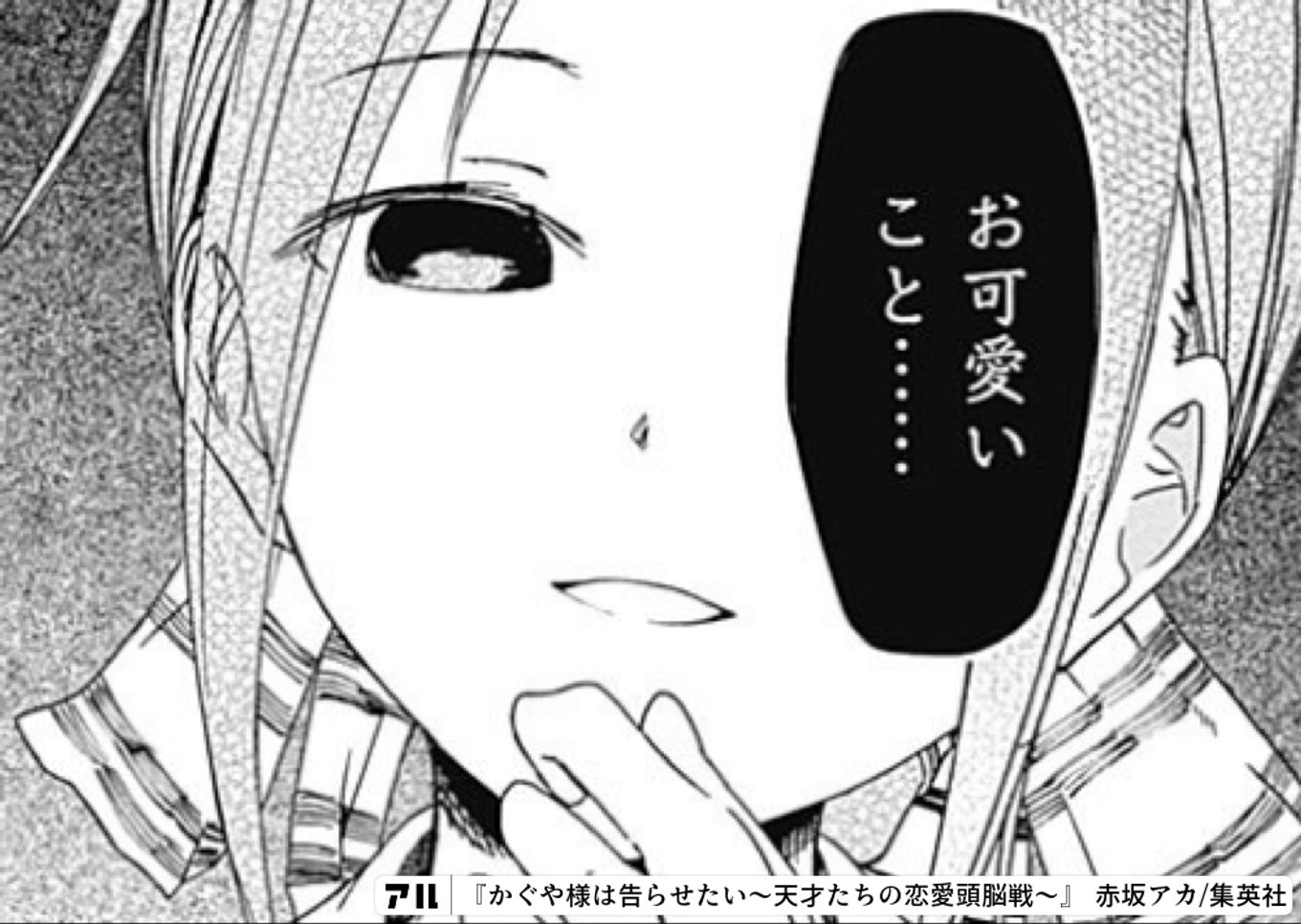
From Kaguya-sama: Love Is War by Aka Akasaka. © Aka Akasaka / Shueisha. Panel shared via alu.jp, an authorized manga panel sharing platform.
Here is the thing that most English-speaking fans do not know: Kaguya Shinomiya, the character most associated with this phrase, has actually said it directly to Miyuki Shirogane exactly once in the first fourteen volumes of the manga. Once. The overwhelming majority of “o kawaii koto” moments are not Kaguya speaking. They are Shirogane imagining Kaguya speaking — a projection of his own insecurity, rendered in manga panels with such visual conviction that millions of readers worldwide remember it as something she routinely says.
The most quoted line in the series is, essentially, a hallucination. This is the kind of detail that keeps linguists employed.
The Grammar of Looking Down on Someone
Let us examine these three words with the seriousness they deserve, which is to say, far more seriousness than any three words in a romantic comedy have ever warranted.
“O kawaii koto” (お可愛いこと) breaks down as follows:
-
O (お): An honorific prefix. In standard usage, it elevates the word it attaches to — “o-genki desu ka” (お元気ですか) is a polite way to ask how someone is doing. But context is everything. When a person of clearly higher social standing uses “o-” while looking down at you with half-closed eyes and the faintest trace of a smile, the honorific flips. It becomes performative politeness. It does not elevate you. It reminds you of the distance between you and the person speaking.
-
Kawaii (可愛い): “Cute.” Except the kanji literally means “possible to love” (可 = possible, 愛い = lovable), which adds a layer of condescension that “cute” in English simply cannot carry. Kaguya is not calling Shirogane adorable. She is noting that he is eligible to be found endearing, in the way a museum visitor might note that a particularly clumsy puppy is eligible to be photographed.
-
Koto (こと): A nominalizer that turns the preceding adjective into an abstract concept. “Kawaii” is “cute.” “Kawaii koto” is “the state of being cute.” This grammatical choice transforms a compliment into an observation — clinical, detached, issued from a great height.
The English translation, “How cute,” captures approximately 40% of what is happening. The remaining 60% is a power dynamic encoded in grammar. Japanese has an entire register system for this — the ability to be devastatingly rude while using exclusively polite language. Every Japanese person has encountered this in real life, usually from a senior colleague who says “o-tsukare-sama desu” (お疲れ様です, “you must be tired”) in a tone that means “I have noticed you are incompetent.”
Kaguya’s “o kawaii koto” is that tone, distilled into three words and weaponized.
Why Japan Uses This on a Daily Basis
The meme escaped the manga almost immediately. By 2019, when the anime adaptation aired and voice actress Aoi Koga delivered the line with varying inflections — sometimes syrupy, sometimes razor-sharp, sometimes with an audible smirk — the phrase had already become a staple of Japanese internet culture. Its use cases include but are not limited to:
The Workplace Deployment: When a junior colleague proudly presents an idea that everyone in the room already considered and rejected three meetings ago. You do not say “we tried that.” You screenshot the Kaguya panel and post it in the team Slack channel. The junior colleague understands. No feelings are hurt, officially.
The Romantic Counter-Strike: When someone you are dating sends an obviously calculated “casual” selfie at 11 PM. The correct response is this panel. It simultaneously acknowledges the effort, exposes the strategy, and maintains plausible deniability. It is the most efficient three words in modern Japanese flirtation.
The Self-Deprecation: When you discover that you have been doing something the hard way for years and someone shows you the shortcut. You post this panel directed at yourself. This usage is technically incorrect — Kaguya’s condescension is always aimed outward — but the internet has never been constrained by authorial intent.
Author Aka Akasaka has commented that the phrase’s repetition was his editor’s suggestion, based on the comedy principle of tendon (天丼) — the Japanese term for a repeated gag that becomes funnier each time. The term “tendon” literally means “tempura rice bowl,” because in a tempura set, the shrimp keeps appearing and you keep eating it. I am not making this up. Japanese comedy theory is named after fried shrimp.
The Part That Gets Lost in Translation
When English-speaking fans use “How cute” as a reaction image, they are deploying a blunt instrument where the original is a scalpel.
The Japanese internet version carries an entire social script: (1) I see what you are doing, (2) I find it transparent, (3) I am choosing to find it endearing rather than pathetic, and (4) I want you to know that this choice is mine and I could revoke it at any time. “How cute” conveys maybe points one and three.
There is also the phonetic dimension. “O kawaii koto” has a specific rhythm — five morae (o-ka-wa-i-i-ko-to) that flow with an almost melodic lilt when spoken with the right intonation. Koga’s anime delivery made this audible to millions of viewers who do not speak Japanese but could hear the condescension. The phrase became an audio meme before most people could translate it.
How to Deploy This Like a Native
If you want to use “o kawaii koto” the way Japanese internet users do, here are the rules:
- Never use it sincerely. The moment you mean it as a genuine compliment, the meme dies.
- The target must have tried and failed to be subtle. This is not a response to overt stupidity. It is a response to transparent cleverness — someone who thought they were being smooth and was not.
- Delivery is everything. In text, follow it with ”…” (the ellipsis is load-bearing). In voice, drop your register half an octave and slow down on the last syllable.
- The Shirogane Principle applies. Remember: the canonical usage is one person imagining another person saying it. If you find yourself mentally hearing “o kawaii koto” directed at someone, you are already using it correctly. You do not need to say it out loud. The meme lives in the anticipation.
There is something philosophically perfect about a phrase that became iconic primarily through one character’s fear of hearing it. Shirogane spent an entire series dreading a sentence that Kaguya almost never actually said. Millions of internet users now say it constantly, to people who have never read the manga, in situations that have nothing to do with romance. The phrase has outlived its context, outgrown its speaker, and become something its author did not plan.
Aka Akasaka, presumably, finds this o kawaii koto.
 Kaguya-sama: Love Is War, Vol. 1 View on Amazon
 * As an Amazon Associate, I earn from qualifying purchases.